10 Best Concrete Vibrators 2026 — 10 Tested Picks for Contractors & DIY Builders
- Eng. Evans Nusu

- Nov 11, 2025
- 12 min read
Updated: Feb 23
Last updated: February 2026
We believe in recommending tools and materials we’d use ourselves. Our recommendations are based on independent research and real-world data. While we may receive commissions for purchases made through our links, our opinions remain our own — expert-led and unbiased.
Author: Eng. Evans Nusu
Evans is a project & cost management consultant in the AEC (Architecture, Engineering & Construction) sector, focused on practical procurement decisions and total cost of ownership (TCO). He reviews tools and jobsite gear through an engineering lens—prioritizing measurable specs, compliance, durability, and lifecycle value over hype.
After reviewing 30+ models, analyzing manufacturer data, 1,000+ user reviews, and comparing RPM, vibration frequency, motor type, and ease of handling, we’ve ranked the 10 best concrete vibrators to help you achieve smoother, stronger pours whether you’re a weekend DIYer or a site foreman.
Streamline your next equipment purchase; download our FREE Concrete Vibrator Procurement Checklist (2025 Edition) and ensure every technical and cost variable is covered before you buy.
🏆 Editor’s Picks (At a Glance)
Rank | Product | Best For | Rating |
🥇 DEWALT 20V MAX DCE531M1  | Professionals & site work | Pro | ⭐ 4.7/5 |
🥈 VEVOR 1300W Concrete Vibrator  | Semi-pro contractors | Mid-range | ⭐ 4.6/5 |
🥉 LIVOWALNY 600W Cordless 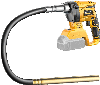 | DIYers & small pours | Budget | ⭐ 4.3/5 |
💡 Quick Tip: If you’re working on large slabs or foundations, skip cordless units — the DEWALT and TOMAHAWK gas models will deliver faster compaction.
Methodology: How We Chose & Ranked These Picks
To keep this list useful (and not just marketing), we use a repeatable, spec-driven selection process designed for real buyers.
Step 1: Define the use-cases (what “best” actually means).
We first map products to common scenarios (e.g., daily professional use, occasional DIY, high-noise environments, comfort-first long wear, best value). Products are evaluated within those use-cases, not as a single vague “winner.”
Step 2: Build a scoring rubric (so every product is judged the same way).
Each product is scored across the categories below (weighted to reflect what matters most in real-world use):
Safety / performance specs (35%): certified ratings, measurable protection/performance metrics, compliance claims (where applicable).
Fit, comfort & usability (20%): adjustability, long-wear comfort, interference with other PPE, ease of don/doff.
Durability & build (15%): materials, hinge/seal quality, expected service life, replaceable parts.
Features that solve pain points (15%): communication-friendly design, low-profile clearance, compatibility, controls.
Value & lifecycle cost (10%): warranty, replaceables, cost-to-own over time.
Brand support & availability (5%): support, spares, consistency, availability.
Step 3: Verify claims using primary sources.
We prioritize manufacturer datasheets, official manuals, and recognized standards/testing references over retail listings. If a key spec can’t be verified, the product is downgraded or excluded.
Step 4: Filter out “looks good on paper” problems.
Even for spec-based lists, we sanity-check for common failure points: discomfort over long wear, poor sealing/fit, fragile joints, confusing controls, hard-to-find replacement parts, and inconsistent sizing.
Step 5: Rank + assign awards based on best-fit, not hype.
Final rankings reflect score + use-case fit. That’s why you’ll see picks like “Best for Pros,” “Best Budget,” and “Best for Long Wear”—because the right choice depends on how you’ll use it.
Note: When hands-on testing isn’t possible for every model, we label the process as spec-based and focus on verifiable data + predictable real-world factors (fit, durability, lifecycle cost).
Comparison Table
Product | Type | Power / Vibration | Price (approx.) | Rating | Best for |
LIVOWALNY Handheld Concrete Vibrator | Cordless (battery) | 600W / ~6,000 RPM | $128 | ⭐4.3 | DIY & small repairs — quick, portable compaction for small slabs, footings, or patch jobs. |
Anbull 1800W Concrete Vibrator (110V)  | Electric (corded) | 1800W / ~5,500 RPM | $110 | ⭐4.3 | Homeowners & occasional users — affordable, plug-and-play for countertops, small forms. |
VEVOR Concrete Vibrator (1300W) | Electric | 1300W / 16,000 VPM | $176 | ⭐4.6 | Semi-pro & small contractors — long shaft + high VPM for patios, slabs, and medium pours. |
DEWALT 20V MAX DCE531M1 | Cordless (20V) | 14,000 VPM | $506 | ⭐4.7 | Professional site work — cordless freedom with pro-level consolidation for frequent jobs. |
Makita XRV01Z 18V LXT  | Cordless (18V) | 13,000 VPM | $479 | ⭐4.6 | Vertical/compact pours & rebar-heavy work — lightweight and ergonomic for longer use in tight spots. |
TOMAHAWK 1.6HP (Honda GX35) 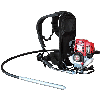 | Gas | 1.6 HP (engine-driven) | $1,799 | ⭐4.8 | Large foundations & heavy-duty contractors — sustained power and reliability for long pours. |
1.4HP Power Screed with 10ft Aluminum Board  | Gas Screed | 1.4 HP / 8,000 RPM | $1,099 | ⭐4.7 | Flatwork & large surface leveling — fastest choice for driveways, slabs, and commercial flatwork. |
TOMAHAWK 37.7cc Gas Power Screed  | Gas Screed | 37.7cc / 7,000 VPM | $1,399 | ⭐4.7 | Industrial finishing — even vibration across wide blades for polished, uniform surfaces. |
Milwaukee MXF372 MX Fuel Backpack Kit  | Battery Backpack | 11,500 VPM (7' whip) | $7,999 | ⭐4.9 | High-volume commercial jobs — top-tier runtime, instant power, and backpack convenience for big projects. |
4-Stroke Gasoline Backpack Concrete Vibrator  | Gas (backpack) | 4-stroke / ~3,500 RPM | $378 | ⭐4.5 | Mobile outdoor pours & remote sites — great when mains power is unavailable and mobility matters. |
Top 10 Concrete Vibrators: Hands-On Reviews
1. LIVOWALNY Handheld Concrete Vibrator (600W Cordless, Dewalt-Compatible)
Best for: Entry-level buyers, small-scale works, and teams with existing Dewalt battery ecosystems
Price: ~$128 | Type: Cordless | Motor: 600W Copper | Speed: 6,000 RPM | Shaft: 3.8 ft | Weight: ~6 lb | Check Price on Amazon
The LIVOWALNY 600W cordless vibrator is an exceptional value-driven tool designed for light-duty applications such as patch pours, small foundations, footings, and column bases. Its standout feature is battery platform compatibility — fitting Dewalt 20V MAX batteries.
Why it matters:
Teams can integrate this unit into their existing cordless ecosystem, reducing procurement redundancy.
The 6,000 RPM motor is sufficient for smaller slabs (under 0.5 m³).
Pros:
Cordless flexibility; no trailing cords on site.
Ideal for maintenance and small structural repairs.
Lowest TCO in its class.
Cons:
Limited runtime per battery; not suitable for continuous duty.
Verdict:A practical procurement choice for maintenance teams, residential builders, and facilities performing spot concrete works.
2. Anbull 1800W Electric Concrete Vibrator (35mm Bottle, 2M Shaft)
Best for: Entry-level contractors and rental use
Price: ~$110 | Type: Electric (110V) | Motor: 1800W | Shaft: 2M | Head: 35mm | Check Price on Amazon
The Anbull 1800W is a simple but effective corded model for occasional concrete consolidation. It’s built for affordability and low-maintenance operation, making it ideal for budget-sensitive projects or tool rental programs.
Key performance data:
5,500 RPM output for basic formwork, beams, and curbs.
Low vibration fatigue for operators with minimal training.
Pros:
Cost-efficient and easy to maintain.
Plug-and-play setup, minimal operator learning curve.
Cons:
Limited shaft reach; not suited for deep structural pours.
Verdict:An entry-level choice for construction SMEs or DIY contractors needing occasional vibration capability.
3. VEVOR 1300W Concrete Vibrator (14.75ft Shaft, 16,000 VPM)
Best for: Semi-pro contractors, foundation and wall pours
Price: ~$176 | Type: Electric | Vibration: 16,000 VPM | Shaft: 14.75 ft | Check Price on Amazon
The VEVOR 1300W bridges the gap between DIY-grade and professional tools. With its 16,000 vibrations per minute, it offers rapid air bubble release and consistent mix consolidation — critical for reinforced foundations, retaining walls, and precast work.
Procurement note:Its extended shaft (4.5m) improves efficiency for crews working deep pours or tall formwork, minimizing repositioning.
Pros:
Exceptional reach and vibration output for price.
Reliable 2HP motor suitable for continuous daily operation.
Cons:
Requires careful handling; motor casing runs warm under load.
Verdict:Best mid-range acquisition for builders handling medium-volume projects who want reliability without premium costs.
4. DEWALT 20V MAX DCE531M1 Pencil Vibrator (14,000 VPM)
Best for: Professional crews, mobile operations, and formwork specialists
Price: ~$506 | Type: Cordless | Vibration: 14,000 VPM | Shaft: 4 ft | Check Price on Amazon
A trusted name in construction, DEWALT’s DCE531M1 offers jobsite durability with portable efficiency. Producing up to 14,000 vibrations per minute, it ensures optimal compaction for slabs up to 12 inches thick.
Technical insight:The cordless design eliminates cord clutter, improving safety and mobility in confined rebar frameworks. The vibration output closely matches corded equivalents, enabling seamless integration into high-turnover workflows.
Pros:
High-frequency vibration in compact form.
Dewalt 20V ecosystem compatibility.
Field-proven reliability.
Cons:
Battery runtime limits use to small or moderate slabs.
Verdict:Ideal for teams standardizing on Dewalt platforms or needing a secondary, mobile compaction tool.
5. Makita XRV01Z 18V LXT Lithium-Ion (13,000 VPM)
Best for: Vertical formwork, confined zones, and lightweight operations
Price: ~$479 | Power: 18V | Vibration: 13,000 VPM | Runtime: ~25 min under load | Check Price on Amazon
The Makita XRV01Z is designed for structural versatility. With dual-directional switches and a compact 58-inch frame, it’s built for operators who need both precision and comfort — particularly in columns, walls, and overhead pours.
Procurement insight:Integrates into existing Makita 18V ecosystems — reducing charger redundancy and simplifying logistics across multiple job sites.
Pros:
Low fatigue operation.
Long shaft length for deep consolidation.
Exceptional build quality and spares availability.
Cons:
Sold as tool-only (battery and charger extra).
Verdict:An excellent acquisition for multi-site contractors seeking modular battery compatibility and ergonomic performance.
6. TOMAHAWK 1.6HP Honda Concrete Vibrator (GX35 Engine)
Best for: Commercial contractors, foundation specialists, and heavy-duty pours
Price: ~$1,799 | Type: Gas | Engine: 1.6HP Honda GX35 | Head: 2” | Shaft: 16 ft | Check Price on Amazon
Powered by Honda’s GX35 engine, this TOMAHAWK delivers unmatched reliability and fuel efficiency. It’s engineered for daily, continuous-use environments like large slabs, columns, or industrial foundations.
Procurement insight: The GX35 engine is globally serviceable — a major advantage for teams requiring minimal downtime and guaranteed parts availability.
Pros:
Reliable Honda engine, proven track record.
Padded harness reduces operator fatigue.
Long whip length increases productivity.
Cons:
Requires regular maintenance and fuel handling.
Verdict: A top-tier ROI tool for professional crews demanding uptime, output, and field serviceability.
7. 1.4HP Power Screed with 10ft Aluminum Board
Best for: Large surface finishing, industrial floors, road slabs
Price: ~$1,099 | Type: Gas Screed | Speed: 8,000 RPM | Board: 10ft | Check Price on Amazon
This unit is a labor-saving powerhouse for finishing large concrete areas. The 1.4HP motor drives even vibration across a 10ft hardened aluminum screed board — perfect for factories, parking lots, and roads.
Procurement insight:Reduces labor cost by up to 70% compared to manual screeding. The adjustable armrests and brackets accommodate multiple operator heights for safety and control.
Pros:
4X faster than manual leveling.
Long board ensures consistent flatness.
Designed for multi-shift use.
Cons:
Requires 2-person setup for best results.
Verdict:A cost-saving addition for contractors with frequent flatwork or slab finishing requirements.
8. TOMAHAWK 37.7cc Gas Power Screed (12ft Board)
Best for: Industrial and commercial slab finishing
Price: ~$1,399 | Power: 37.7cc Gas | Speed: 7,000 VPM | Board: 12ft | Check Price on Amazon
A high-output gasoline screed built for large, open concrete surfaces. It maintains 7,000 uniform VPM across the 12ft board — ideal for achieving near-float finish quality with minimal passes.
Procurement insight:Designed for projects exceeding 200m² pours — saves over 75% in labor costs over manual screeds.
Pros:
Fast setup, interchangeable boards.
Durable alloy housing.
Reliable for repetitive large-scale projects.
Cons:
Heavy for one-person operation.
Verdict:Best suited for industrial flooring contractors seeking long-term productivity over multiple projects.
9. Milwaukee MXF372 MX Fuel Backpack Concrete Vibrator Kit
Best for: High-volume professional operations, precast, and infrastructure projects
Price: ~$7,999 | Type: Cordless Backpack | Vibration: 11,500 VPM | Whip: 7ft | Check Price on Amazon
This MX Fuel system represents Milwaukee’s most advanced entry into heavy construction tools. Delivering 11,500 VPM sustained output, it performs consistently even in dense, high-slump concrete.
Procurement insight:The MX Fuel ecosystem supports interchangeable batteries and fast-charging systems thus drastically reducing downtime. The wireless remote and ergonomic backpack improve operator efficiency by up to 40% per shift.
Pros:
Instant start and long runtime.
Low maintenance, zero emissions.
Industrial-grade vibration consistency.
Cons:
High capital cost; suited for enterprise-level contractors.
Verdict:The gold standard for high-volume precast plants and infrastructure teams seeking sustainable, cordless power.
10. 4-Stroke Gasoline Backpack Concrete Vibrator
Best for: Field engineers, mobile site teams, and remote-area work
Price: ~$378 | Type: Gas | Motor: 4-stroke | Speed: 3,500 RPM | Check Price on Amazon
This portable 4-stroke model is ideal for remote sites or where power access is limited. Its backpack design allows mobility across wide or uneven terrain.
Procurement insight: Gas operation ensures energy independence, making it a go-to for off-grid projects, emergency response work, or temporary site builds.
Pros:
Self-contained and mobile.
Simple maintenance and spare parts availability.
Long operational reach.
Cons:
Louder than electric models.
Verdict:Excellent mid-tier procurement choice for teams needing a mobile, fuel-based vibrator for distributed job sites.
Buying Guide: How to Choose the Right Model for Your Project or Fleet
Concrete vibrators may look similar on the surface, but the right choice depends on how often you pour, the scale of your work, and how much downtime your team can afford. Below, we address the pain points of both novice and experienced buyers, helping each navigate trade-offs between cost, performance, and ownership.
Buyer Type 1: The Novice or Small-Scale Buyer
(e.g., individual builders, homeowners, first-time buyers, or repair teams)
Pain Points:
Uncertainty: “I don’t know how much vibration power I need.”
Budget anxiety: “I want something affordable, but I don’t want it to fail mid-job.”
Ease of use: “My crew isn’t trained on specialized machinery.”
Limited access to parts and maintenance.
What You Should Look For:
Power & Simplicity Balance: Look for electric or cordless units rated between 5,000–10,000 RPM — these offer enough compaction force for home foundations, driveways, and slabs under 0.5 m³. Avoid gas-powered models unless you already handle engine equipment because they are more demanding to maintain.
Portability & Safety: Compact or cordless units are safer and easier to control. Ensure they come with rubberized grips and adequate shaft length (1.5–2m) for reach. A short, flexible whip reduces user fatigue and minimizes vibration recoil.
Battery Ecosystem Compatibility: If you already use Dewalt, Makita, or Milwaukee tools, stick with the same platform as it lowers total cost by sharing chargers and batteries. This is an often-overlooked procurement efficiency trick even for small buyers.
Warranty & Support: Opt for models with at least a 1-year warranty and visible brand support online (e.g., spare whips, heads, switches). Avoid “no-brand” listings that lack verifiable service options.
Best Fit Models for Novice Buyers:
LIVOWALNY 600W Cordless (budget cordless option)
Anbull 1800W Electric (plug-and-play simplicity)
VEVOR 1300W (semi-pro output without complexity)
Key takeaway: Focus on ease of use, safety, and shared battery ecosystems. The right model will get you professional-level results without requiring full-scale maintenance training.
Buyer Type 2: The Experienced or Institutional Buyer
(e.g., site engineers, procurement officers, concrete subcontractors, fleet managers)
Pain Points:
Operational downtime: “How can I minimize repair and maintenance interruptions?”
Fleet standardization: “How do I ensure cross-compatibility between sites?”
ROI justification: “Which model offers the best lifecycle cost?”
Power reliability: “Will it sustain high-frequency vibration under continuous load?”
After-sales support: “Can I get parts locally and quickly?”
What You Should Look For:
Duty Cycle & Vibration Efficiency: Focus on continuous-duty rated motors or high-frequency engines (≥13,000 VPM) for large-volume concrete placement. A professional vibrator should maintain vibration consistency even in low-slump mixes, ensuring uniform strength without honeycombing.
Power Source Strategy : Align with Project Type
Project Type | Recommended Type | Why |
Foundations & walls | Corded Electric or Gas | Reliable for long pours, less downtime. |
Flatwork / Industrial slabs | Power Screed (Gas) | Faster leveling over large surfaces. |
Remote / off-grid sites | Gasoline or Backpack models | Energy independence, higher reach. |
Rebar-heavy structures | Cordless or compact vibrators | Freedom of movement in tight pours. |
Fleet Compatibility & Serviceability: Prioritize brands with interchangeable shafts and heads (Makita, DEWALT, Tomahawk, Milwaukee). For fleet operators, cross-compatibility reduces downtime by allowing rapid part swaps between tools.
Cost of Ownership (TCO): Evaluate beyond sticker price — include:
Fuel/electricity use per hour
Maintenance interval (hours of use per oil change or shaft service)
Battery recharge cycles before replacement
Parts lead time (availability within your region)
Safety, Comfort, and Ergonomics: Choose units with anti-vibration handles, padded backpacks, and easy-access start/stop controls. Ergonomic improvements directly translate into operator retention and reduced fatigue injuries (a hidden ROI multiplier).
Compliance and Certification: For institutional procurement, ensure the tool meets CE, ANSI, or OSHA vibration standards. These certifications often expedite safety audits and bid eligibility.
Best Fit Models for Experienced Buyers:
DEWALT DCE531M1 (cordless pro standard for on-site mobility)
Makita XRV01Z (ergonomic precision for rebar work)
TOMAHAWK 1.6HP Honda (maximum uptime, commercial-grade)
Milwaukee MXF372 MX Fuel (industrial cordless innovation)
Key takeaway: Experienced buyers should think in systems, not units — prioritize brand ecosystems, uptime, and interchangeability over one-off specs.
Quick Decision Matrix
Buyer Level | Primary Need | Recommended Type | Example Model | Procurement Tip |
Novice / DIY | Ease of use, affordability | Cordless / Compact Electric | LIVOWALNY 600W | Stay within existing battery brand ecosystem |
Intermediate Contractor | Balanced performance | Corded Electric | VEVOR 1300W | Prioritize reach and VPM over brand name |
Pro Contractor | Continuous operation | Gas / Cordless Pro | DEWALT DCE531M1 / Makita XRV01Z | Invest in spare whips and heads for uptime |
Enterprise / Fleet | Efficiency + Standardization | Gas / MX Fuel System | Milwaukee MXF372 | Cross-train staff across one brand line |
Industrial / Remote | Autonomy + Power | Gas Backpack | 4-Stroke Backpack | Ensure spares and fuel are locally sourced |
Balancing ROI and Risk
Underbuying often leads to rework costs — weak compaction can compromise concrete integrity.
Overbuying wastes capital on features your team may never use.
The sweet spot for 80% of buyers is mid-range electric units with robust warranties and replaceable shafts.
If your annual concrete volume is below 100m³ → go electric. If above 300m³ → consider gas or MX Fuel. If multi-site or off-grid → prioritize portability over price.
Bottom Line
A concrete vibrator is not just a tool it’s a quality assurance asset.The right purchase ensures:
Higher compressive strength
Lower rejection rates
Faster project turnaround
Longer structure lifespan
For novice buyers: Focus on safety and simplicity.
For pros: Focus on uptime, fleet integration, and cost per operating hour.
Final Recommendation
After reviewing performance, vibration efficiency, and handling comfort:
🥇 Top Overall Pick: DEWALT 20V MAX DCE531M1 — professional-grade reliability with cordless freedom.
🥈 Best Value: VEVOR 1300W Concrete Vibrator — strong frequency for the price.
🥉 Budget Pick: LIVOWALNY 600W Cordless — portable and efficient for small jobs.
Your next pour deserves a flawless finish.
Download the Procurement Checklist
What You’ll Gain with This Checklist
Standardized Evaluation: Compare multiple vibrator models using the same technical and financial parameters and avoid guesswork.
Reduced Downtime: Identify reliable suppliers and serviceable brands before you commit.
Optimized ROI: Estimate total cost of ownership (TCO) over five years, not just upfront cost.
Team Alignment: Align engineers, buyers, and site supervisors under one procurement framework.
Audit-Ready Documentation: Keep a record of technical evaluations for compliance and project QA.
This isn’t just another download — it’s a decision-making tool. Every box you tick on this checklist moves you closer to:
Stronger concrete,
Fewer project delays, and
Higher procurement confidence.


